As the first day of Winter has passed, the growing season has concluded in the Commonwealth. This may appear to be time for native plant enthusiast to close up shop until the beloved Spring ephemerals make their appearance in March. However, the Kentucky landscape provides plant lovers with many opportunities to botanize during these colder months, and I hope to share some of the groups you can learn as well as the resources I would recommend! While winter identification will be a bit more esoteric than having leaves and flowers at one’s disposal, it is a challenge I encourage everyone to take a jab at.
If there’s wood… there’s a bud!
From the largest of tress to the smallest of vines, if a plant has wood, then this necessitates a bud to protect next year’s leaves. While buds are smaller and look more similar to one another than flowers and leaves, they can give great clues to what species you might be looking at. Sometimes the buds can be more trustworthy than leaves as well!
Pictured on the left is Red Maple (Acer rubrum) and on the right is Kentucky’s state tree the Tulip Poplar (Liriodendron tulipifera) both displaying their buds awaiting a botanist’s identification!
Evergreen
An obvious choice is to look for species that keep their leaves all year. This can range from ferns (see below) and gymnosperms (Pines and Spruces) to the angiosperms (like American Holly). While there will not be as many species to identify during the winter that have their leaves on display when compared to the summer months, there are still some species to appreciate.
Pictured is the Christmas Fern (Polystichum acrostichoides) which can be found year-round.
Mosses
I usually find the mosses to be the most challenging group of plant life to tackle, but, alas, the mosses do provide plant lovers to pursue their quest to learn what mother nature holds in store for us.
Resources
Below is one app and two books that can help with you winter botanical adventures:
This is a great resource for getting an identifier in the ballpark. The app may not do too well with pictures of buds especially if the pictures are not of the best quality, but it is worth a try. If you need instructions on how to use the app, check out the following Lady Slipper article from a previous issue: iNaturalist Tutorial
A great resource for moss identification for our area. Mosses are difficult to identify so this book may only help you get to family or genus, but some you might be able to get to species!
Hello KNPS members! I am writing to encourage you to become a part of the editorial. We are all volunteers and could use your help in many ways. From checking for grammar to writing submissions, you can be involved in the smallest to the largest of ways. Even if you can only help for 15 minutes a month, your involvement in the Lady Slipper would be extremely beneficial! If you would like to join, have any questions, or have an article idea, please email ladyslipper@knps.org. Thank you!
The Lady Slipper newsletter of the Kentucky Native Plant Society has been published since the Society’s founding in 1986. This is one of a series of reprints from past issues. This article, about Kentucky’s oldest documented trees, first appeared in Vol. 24, No. 2, Winter 2009. If you would like to see other past issues, visit the Lady Slipper Archives, where all issues from Vol. 1, No. 1, February 1986 to Vol. 34, No. 1, Winter/Spring 2019 (after which we moved to this blog format) can be found.
Floracliff’s Old Trees: Acorns of Restoration for the Inner Bluegrass Region
By Neil Pederson, Eastern Kentucky University
“Woodie C. Guthtree”, Kentucky’s oldest known living tree at 398 years. Photo by Beverly James.
Old trees are windows into historical events. The science of tree-ring analysis takes advantage of a characteristic common to all trees: no matter how bad things get – an approaching fire, tornado, drought, etc. – trees must stay in place and absorb these abuses. Though each tree is an individual, environmental events like these impact all trees in a similar fashion: events that limit a tree’s ability to gain energy reduce the annual ring width. Scientists interpret patterns of ring widths within tree populations to reconstruct environmental history. To date, tree-ring scientists have successfully reconstructed drought history, Northern Hemisphere temperature, fire histories, insect outbreaks, etc. Tree-ring studies have also enriched human history. Scientists have dated logs from ancient structures that, in turn, triggered revisions of human history. Similarly, tree-ring evidence indicates that a severe drought likely contributed to the failure of The Lost Colony in Roanoke, NC and to the outbreak of a highly-contagious disease and subsequent crashes of the human population in ancient Mexico City. Just a few old trees in a small landscape can shed light into long-forgotten or unobserved events.
Floracliff Manager Beverly James cores “Old Twisty”.
In late-summer ‘08, Beverly James, manager of Floracliff Nature Sanctuary, contacted me about sampling some trees in Floracliff to gain insight into the preserve’s ecological history. Having been in Floracliff previously, I was skeptical of coring its trees. It is so close to a major corridor (even pre-Daniel Boone), has a series of fields within the sanctuary, is dominated by a second-growth forest being overrun by bush honeysuckle and lies in the vicinity of the oldest European settlements in Kentucky. How and why could old trees survive these conditions? I feared that the coring of any trees here would reveal little beyond the fact that Floracliff was a young forest heavily cut within the last 100 years.
Later that fall, with permission from the Kentucky State Nature Preserves Commission and a great crew, including Dr. Ryan McEwan of University of Dayton, Ciara Lockstadt (a volunteer assistant at Floracliff), and Chris Boyer (undergrad at Eastern Kentucky University), the six of us cored 20 living chinkapin oaks. The first tree we cored came in at 372 years, the oldest documented tree in Kentucky—a record, it turns out, that did not last more than 30 minutes. Our second tree came in at 398 years and is now the oldest-documented tree in Kentucky. Named “Woodie C. Guthtree”, he now has his own “Facebook” page [Visit Woodie C. Guthree’s FB page].
Floracliff’s old growth “epicenter” by Beverly James.
I teach a course on the ecology of old-growth forests. A reoccurring theme of the course is, “What is an old-growth forest?” As our society moves farther and farther away from the 1600s and fully appreciates the value of biological conservation, this question becomes pertinent. If the definition of an old-growth forest is simply a forest untouched by people of European descent, then there are no old-growth forests and little incentive to protect once, twice or thrice disturbed forests. However, if we define old-growth forests using the philosophy of Michael Pollan, who states that old-growth forests (or anything natural) will only persist because of human will, then it makes sense to allow the influence of humans into the old-growth forest definition. Making this allowance then allows for future creation and restoration of old-growth forests, a concept that the former definition makes impossible.
To be clear, these old trees are cull trees in a second-growth forest – these trees were left behind by loggers because they were seen as “inferior”. They did not grow to be prime, sawboard-producing trees. Their value, in my mind, is great. Not only have they been witnessing changes in the environment since well before Daniel Boone stepped foot into Kentucky, they are an important link to the past in an area that has more legend right now than facts. Floracliff and its Original Individuals can be a core for the recovery of the Inner Bluegrass landscape. See, while these trees were not considered “superior” when the Floracliff was cut, they contain genetic structure that is directly tied to pre-European forests. There was likely a loss of genetic diversity with logging. Yet, the architecture of the Original Individuals, which is what allowed them to live through the pre-sanctuary era, was likely shaped by what they struggled against to survive – direct competition, rather than weak genes. Plants seem to carry multiple copies of their genes. And, if the new discipline/area of study epigentics is any indication, genes are dynamic; a tree’s DNA system might be more dynamic than previously thought. Hope might genetically spring anew from these old chinkapin oaks.
Neil Pederson with “Woodie.”
As this chapter of environmental investigation closes, I look forward to the future of Floracliff and discoveries of the environmental history of the Inner Bluegrass Region. Floracliff is an emerald of the Inner Bluegrass; it can seed restoration of future old-growth forests while providing hope for the discovery of more forests with similar connections to ancient times. Floracliff will also be the lead forest in the reconstruction of regional environmental and human history. Its trees can help us answer questions such as, “What was the climate like during the settlement of Fort Boonesborough, Harrodsburg and Danville?” and “Were there any large-scale disturbances in the forests of the Inner Bluegrass region during the last 300 years?” The rare old trees of Floracliff will reveal important slivers of historical Fayette County ecology – slivers which will allow us to ponder and construct plans for a more sensible and hopeful future environment.
Produced from the FloraManager database system by Michael T. Lee
University of North Carolina at Chapel Hill Herbarium (NCU), North Carolina Botanical Garden, University of North Carolina at Chapel Hill
The 2020 edition of the Flora of the Southeastern United States, covering over 10,000 species, was published in October. The Flora covers the biogeographic region of the moist, relictual, unglaciated southeastern North America: south of the glacial boundary and east of the “dry line” to the west that marks a marked floristic boundary to the Great Plains prairies to the northwest and the Madrean woodlands and scrub to the southwest. By states, this means that coverage includes the states of Alabama, Arkansas, Delaware, Florida, Georgia, Kentucky, Louisiana, Maryland, Mississippi, New Jersey, North Carolina, Pennsylvania, South Carolina, Tennessee, Virginia, West Virginia, and the District of Columbia, and parts of Texas (the eastern Pineywoods, Coastal Prairies, Cross Timbers, Blackland Prairies, and South Texas Sand Sheet), Oklahoma (eastern Interior Highlands and Cross Timbers), Missouri (southern Interior Highlands), and Illinois, Indiana, and Ohio (southern unglaciated portions).
The Flora of the Southeastern United States is an open access, collaborative resource about the plants of the southeastern quarter of the United States. The Flora can be downloaded for free from the University of North Carolina’s North Carolina Botanical Garden’s website:
The NC Botanical Garden and UNC Chapel Hill Herbarium will publish 30 additional “derivative floras” covering smaller portions of the region (physiographic regions and states) that will be ‘handier’ for many users.
From Dr. Alan S. Weakley: “As a reminder to those who have downloaded (or will download) the full Flora or who will download the derivative floras, we give it away for free not because it is so cheap, but because it is so valuable and important — that it should be open access.
However, it IS costly to develop and produce, and,
if you value its contents (consider what you would pay for this amount of information in most floras), and
especially if you use it for commercial purposes, and
ONLY if you are able, … we encourage you to support the work that goes into this open access, collaborative resource about the plants of the southeastern quarter of the United States. We will use funds received to make the 2021 edition better and more responsive to your needs (let me know your wishes, at weakley at unc.edu). But please, donate if you can.”
For years, the Kentucky Native Plant Society has sold t-shirts with our logo at our annual events. With the online KNPS Gear Shop at the KNPS website you can purchase t-shirts and other items from the comfort and safety of home.
In the shop we currently have heavy cotton unisex t-shirts, kid’s t-shirts, long sleeve t-shirts, men’s polo shirts, women’s t-shirts, hooded sweatshirts, and crew neck sweatshirts. In addition, we have coffee mugs, stainless steel water bottles, and a ruled line notebook. The items in the shop have our KNPS logo that features the rare and beautiful Kentucky lady’s slipper orchid (Cypripedium kentuckiense).
In response to the COVID-19 pandemic and recognizing that we will likely need to wear masks for many months to come, we have recently added a three layer face mask to the Shop. The mask has outer layers of polyester, with an inner layer of cotton. The mask is 7″ wide and 4.5″ high.
The products in the KNPS Gear Shop come from a Print-On-Demand service. Each product is produced by the manufacturer at the time of the order. Neither KNPS nor the manufacturer maintains any inventory. Because of this returns or exchanges are not possible if you order a wrong size, color, or simply don’t like the product. Please carefully double check any order before placing it. We can make exchanges if the product arrives damaged in some way.
Hope that you will take some time and visit the Gear Shop in coming days.
The Lady Slipper newsletter of the Kentucky Native Plant Society has been published since the Society’s founding in 1986. This is one of a series of reprints from past issues. This article, about North America’s largest native fruit, the pawpaw (Asimina triloba), found in every county of KY, first appeared in the fall of 2005, Vol. 20, No. 3. If you would like to see other past issues, visit the Lady Slipper Archives, where all issues from Vol. 1, No. 1, February 1986 to Vol. 34, No. 1, Winter/Spring 2019 (after which we moved to this blog format) can be found.
The author, John Thieret, left a huge legacy to the native plant community when he passed in 2005. “Kentucky has lost its most renowned American plant taxonomist of the 20th century. John W. Thieret, Professor Emeritus of Biological Sciences at Northern Kentucky University, retired Director of the Northern Kentucky University Herbarium, Associate Editor of Sida, Contributions to Botany, and Editor of the Journal of the Kentucky Academy of Science (JKAS) passed away on 7 December 2005, at Alexandria, Kentucky.”
To learn more about this giant of Kentucky Botany, read the articles and tributes to him in the Winter 2005/Spring 2006, Vol. 20, No. 1, of the Lady Slipper archives.
Kentucky’s ‘Tropical’ Fruit, the Papaw
by John Thieret, NKU
Photo: Ellwood J.Carr, from the collection of the Pine Mountain Settlement School
A visit to a fruit/ vegetable market in the tropics is a great experience. All sorts of plant products that we in the temperate zones do not recognize are there. Among these are fruits of the Annonaceae, the custard-apple family, including the bullock’s-heart, cherimoya, guanabana, sweetsop, and soursop. These are unknown to most people in our part of the world, but we do have a member of the Annonaceae that does NOT grow in the tropics, our papaw, Asimina triloba. This is a shrub or small tree, which, as I have seen it, never exceeds perhaps 20 feet in height and 6 inches in trunk diameter, although there are reports of individuals 50 feet tall and with a trunk 2 feet in diameter, truly a mega-papaw.
A common enough plant, the papaw thrives in rich woods over much of eastern U.S. from northern Florida to far eastern Texas, then north to New York, far southern Ontario, Michigan, Iowa, and southeastern Nebraska. It grows throughout Kentucky, almost certainly in every county.
Although some papaw enthusiasts wax ecstatic over the fruits, papaws are not everyone’s favorite. This divergence in appreciation stems from, first, natural differences in fruits from different trees and, second, differences in people’s taste buds. I have found fruits from some trees not worth the effort of trying to get them down from the branches. But other trees can produce fruits that I’d describe as almost excellent. The best papaws I ever tasted were in southern Illinois on a rather cool, almost frosty fall morning. Yes, quite worthwhile. The Indiana poet James Whitcomb Riley described, in hoosier dialect, the gustatory experience:
And sich pop-paws! Lumps a’ raw Gold and green,—jes’ oozy th’ough With ripe yaller—like you’ve saw Custard-pie with no crust to.
Another assessment of the taste, by an Indiana lad, is included in Euell Gibbons’ book Stalking the Wild Asparagus: “They taste like mixed bananers and pears, and feel like sweet pertaters in your mouth.” I’ll second that, at least for a good papaw.
Long before Europeans began their assault on the North American continent,the indigenous peoples, along with various animals—possums, raccoons, squirrels, and skunks—sought the fruit. The first Europeans to see it—some 450 years ago—were De Soto and his entourage. They wrote of it, mentioning its “very good smell and excellent taste.” About 200 years later the plant was introduced into cultivation by Europeans who brought seeds to England. Then in1754 the first illustration of the papaw appeared in Catesby’s Natural History of Carolinas (see right). Lewis and Clark, in the early 19thcentury, found the fruits to be welcome additions to a meagre diet. To this day, the fruits are collected and used by country people and by city dwellers who like to eat their way through the landscape.
As for ways to use the fruits, first and foremost they can be eaten out of hand. As they ripen, they change from green to brown or nearly black, then looking not especially appetizing (recalling ripe plantains). The fruit pulp, creamy and sweet, contains several large,flattened, brown seeds. One of my friends made a necklace for his wife from the seeds. Better, I guess,than one made from finger bones.
Enthusiasts use the fruit for pies, puddings,marmalade, bread, beer, and brandy. I’ve tasted papaw bread and found it OK. Barely. I once tried to make papaw bread—I’ll say no more about that dismal experience. (The persimmon bread I attempted was no better.)
On a few occasions I have seen the plant grown as an ornamental. With its large, somewhat drooping leaves, it is rather attractive. The maroon flowers,which bloom in spring when the leaves are still young and covered with rusty down, are not all that conspicuous, and the fruits—well, my experience has been that papaw plants in cultivation as lawn specimens just do not make many fruits. As a matter of a fact, I have always noted that, even in the wild,the fruits are not abundantly produced. Maybe I just was not at the right place at the right time. The plants seem to require cross pollination, which is a disadvantage to those who would use them as ornamentals and, at the same time, would like some fruits.
If you have never tried one of the fruits, head for the woods in the autumn and attempt to find one. Maybe someone you know can help you. Even if you do not find the fruit much to your liking—maybe you will,maybe you won’t—you will have had a new gustatory experience.
For many years attempts have been made by horticulturists to ‘improve’ the papaw and make it into a commercially viable fruit. Their efforts notwithstanding, the fruit remains a Cinderella. On only one occasion have I seen papaws for sale: at a roadside farmer’s stand in southwestern Ohio among a fine display of squashes of a dozen kinds. Breeding and selection work has been carried out in several places, notably at Kentucky State University where about 1700 papaw trees grow in KSU’s 8-acre experimental farm and where the PawPaw Foundation is headquartered. Once, in Pennsylvania, I saw a papaw orchard of maybe 50 trees. I wish now that I had stopped and spoken with the orchard’s owner.Perhaps, with continued efforts at breeding and selection, papaws might some day be common items in our temperate fruit and vegetable markets, as common even as are the annonaceous cousins of Asimina triloba in markets of the tropics. This is the goal toward which papaw enthusiasts and breeders are striving.
The Lady Slipper newsletter of the Kentucky Native Plant Society has been published since the Society’s founding in 1986. This is one of a series of reprints from past issues. This article, about one of Kentucky’s loveliest goldenrods, first appeared in the spring of 2005, Vol. 20, No. 1. If you would like to see other past issues, visit the Lady Slipper Archives, where all issues from Vol. 1, No. 1, February 1986 to Vol. 34, No. 1, Winter/Spring 2019 (after which we moved to this blog format) can be found.
The author, Mary Carol Cooper, left a huge legacy to the native plant community when she passed in 2016. In almost every native plant gathering, her name is mentioned and a moment is given over to appreciate her knowledge, which she freely shared. Her passion led many of us to our love of natives; she was a mentor and friend to many of us.
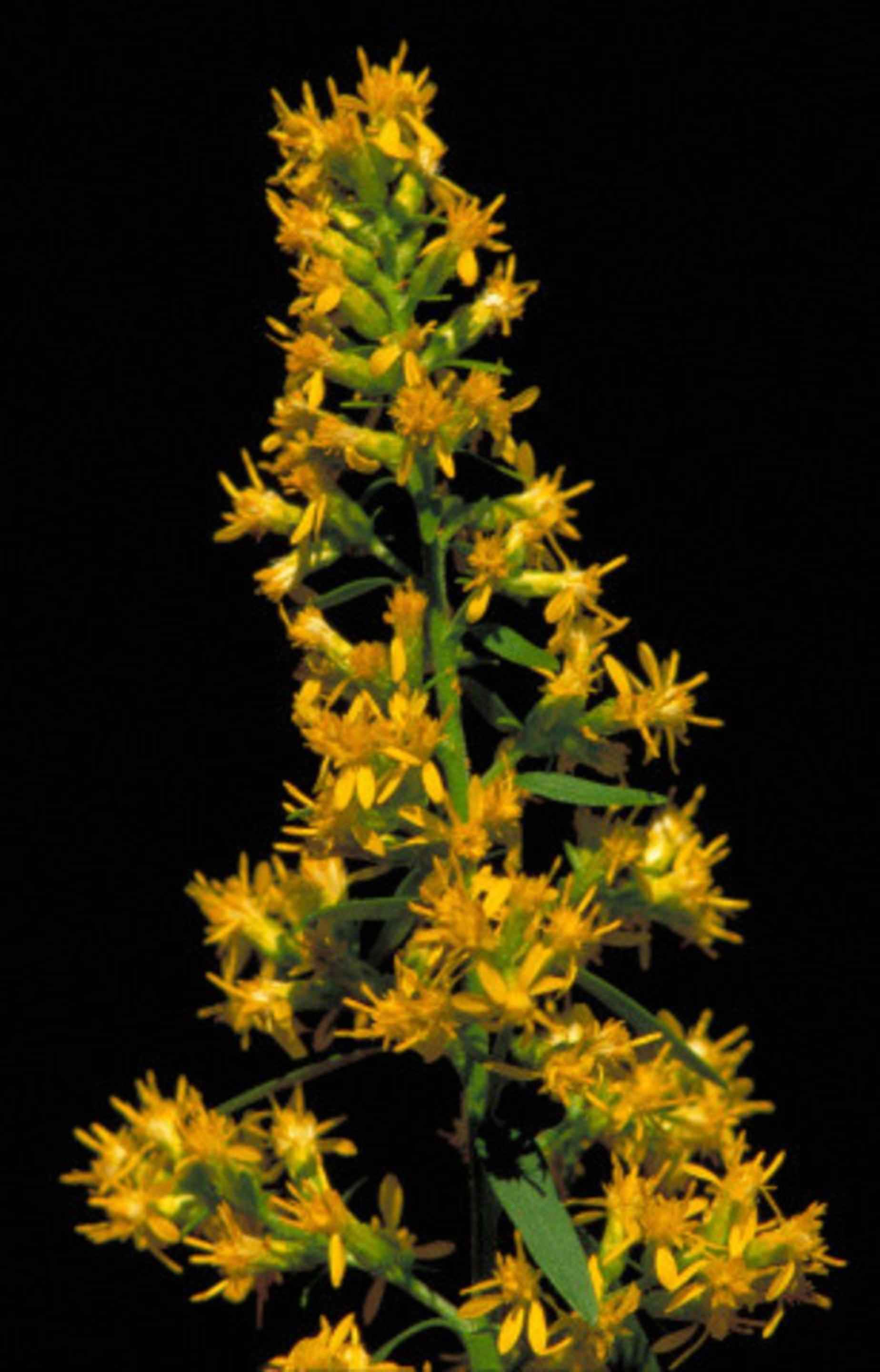
2005 Wildflower of the Year SHOWY GOLDENROD (Solidago speciosa)
By Mary Carol Cooper Salato Native Plant Program Coordinator Salato Wildlife Education Center
Photo by Tom Barnes
Wildflower enthusiasts from all across the state have selected Showy Goldenrod (Solidago speciosa) as the Salato Native Plant Program’s Wildflower of the Year for 2005. The Wildflower of the Year is chosen based on the number of nominations it receives and how well it fits the established criteria; must be native to Kentucky, common and widespread across the state, seeds must be readily available, must be easy to grow, and must have good wildlife value.
Showy Goldenrod is a hardy perennial that grows 2 to 6 feet tall, depending on where it is planted. It is a rather showy species with stout, smooth, reddish stems and smooth, deep green leaves that are 4 to 10 inches and not toothed. It grows in rich thickets, woodland openings, fields, and prairies. It likes average to well drained soil and grows in sun to partial sun. It has dense upright pyramidal flower clusters. Each flower head has 6 to 8 rays. Showy Goldenrod blooms in late in the summer (August to September) and is wonderful as a late summer nectaring source for bees, butterflies and hummingbirds. It also provides food for several species of songbirds such as the Goldfinch, Junco, Pine Siskin, Song and Tree Sparrows.
Goldenrods are insect pollinated and their pollen is heavy and sticky. Therefore their pollen is never in the wind, so contrary to popular belief, this is not the plant that has always been blamed for causing hay fever. It is ragweed that causes all the misery! Ragweed blooms at the same time and is wind pollinated. I’ve enjoyed watching more and more floral designers use goldenrods in their arrangements and wonder how many people are aware that their lovely bouquet is full of the “dreaded goldenrod”.
Goldenrod is truly a North American flower. There are approximately 125 species in North America and more than 30 of these are native to Kentucky. Since the State Flower is Solidago ssp. this must mean that we have 30 State Flowers! Two of out native goldenrods, White-Haired Goldenrod and Short’s Goldenrod are on the Federally endangered species list.
Showy Goldenrod makes a nice background or midground plant in a sunny perennial garden. Establish this plant at the very rear of the garden or in the very middle of a circular or oval garden. Allow 3 feet between plants as this species grows into large clumps very fast. They can be divided every year or so and given to friends and neighbors. Nice companion plants are Ironweed, Great Blue Lobelia and New England Aster. Plants naturalize quickly on dry sunny banks. The cuttings are outstanding in arrangements.
The genus name Solidago comes from the Latin word that means “to make whole” or “to heal”, a name chosen because of medicinal power the plant was believed to have. The Native Americans used this plant for many things including ridding people from pain and evil spirits. One Goldenrod superstition says that he who carries the plant will find treasure, therefore, Goldenrod is the symbol for treasure and good fortune.
Goldenrod seeds and plants are available from many native plant nurseries. It is also very easy to propagate either by seeds, or division. Sow seeds thickly in outdoor seedbeds early in the fall or sow stored seed later in a flat indoors or in a cold frame. Transplant when there are 3 to 4 leaves. When the roots fill the pot, transplant in the garden after the last frost date. Collect seeds in late September or October. Cut off seed heads and put them upside down in a large paper bag. Let them dry for up to a week and then shake them in the bag and put the seeds in a sealed container.